By Moses Desire Kouyo
For too long, Africa has treated Africans like foreigners in their own continent.
A businessman from Europe could enter many African countries with fewer obstacles than a trader from Lagos or a student from Nairobi. Colonial borders hardened into psychological barriers. Bureaucracy became a weapon against African movement. And governments that spoke passionately about Pan-African unity often maintained immigration systems that contradicted everything they claimed to believe.
That is why Ghana deserves commendation.
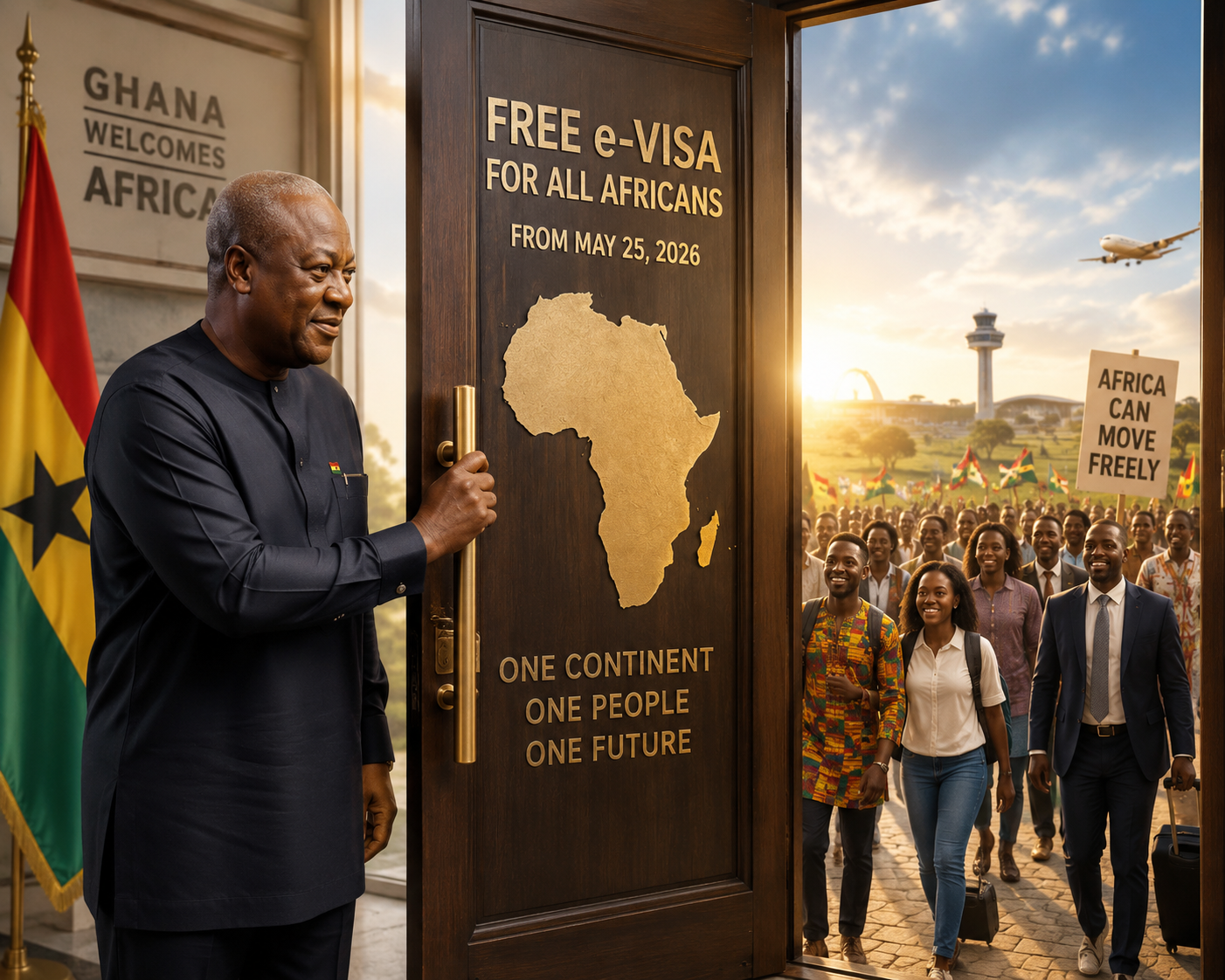
On Africa Day 2026, President John Dramani Mahama announced a historic free e-Visa policy for all Africans alongside the launch of Ghana’s first electronic visa platform. The policy allows Africans to apply online and receive visas free of charge while still undergoing standard security screening procedures.

This is more than an immigration reform.
It is a political statement.
It is Ghana declaring that African unity must move beyond conference speeches and become institutional reality.
At a time when much of the world is building higher walls, weaponizing migration fears, and retreating into nationalism, Ghana has chosen a different path: openness grounded in African solidarity. That choice deserves respect.
Because the truth is uncomfortable.
Africa cannot continue preaching continental integration while making it unnecessarily difficult for Africans to cross African borders. The African Continental Free Trade Area cannot succeed if movement remains trapped in outdated bureaucracy. Trade requires mobility. Innovation requires connectivity. Pan-Africanism requires trust.
And trust cannot grow where Africans are treated as suspicious outsiders by fellow Africans.
The significance of Ghana’s decision also lies in its symbolism. Ghana has historically positioned itself at the ideological center of Pan-African thought, from Kwame Nkrumah welcoming liberation movements in Accra to its modern diplomatic role within ECOWAS and AfCFTA. This policy continues that tradition. It reminds the continent that Pan-Africanism was never supposed to remain poetry. It was supposed to become policy.
Critics will raise concerns about security, migration abuse, and economic strain. Those concerns should not be dismissed carelessly. But Ghana’s government has already clarified that all travellers will still undergo mandatory security vetting integrated with international passenger and crime databases.
In other words, Ghana is not abandoning security.
It is abandoning fear.
And there is a difference.
For decades, African states have opened their economies to exploitative foreign interests while restricting ordinary Africans from moving freely across the continent. Foreign corporations extract gold, oil, cobalt, and timber with astonishing ease. Yet an African entrepreneur often struggles more to obtain a visa than a multinational company struggles to secure a mining concession.
That contradiction has always exposed the hypocrisy of post-colonial governance.
Ghana’s policy does not solve every problem confronting the continent. It will not magically industrialize Africa or erase corruption. But it challenges a dangerous mindset: the belief that African borders must remain barriers between African people.
That mindset has cost the continent dearly.

Ghana has done something rare in modern African politics: it has aligned rhetoric with action.
While others continue to issue declarations about African unity from luxury conference halls, Ghana has taken a concrete step toward making the continent more connected, more accessible, and more African.
The rest of the continent should pay attention.
Because history does not only remember nations that protect borders. It remembers nations that expand possibility.
And on Africa Day 2026, Ghana chose possibility.